

Interview with @autiblog
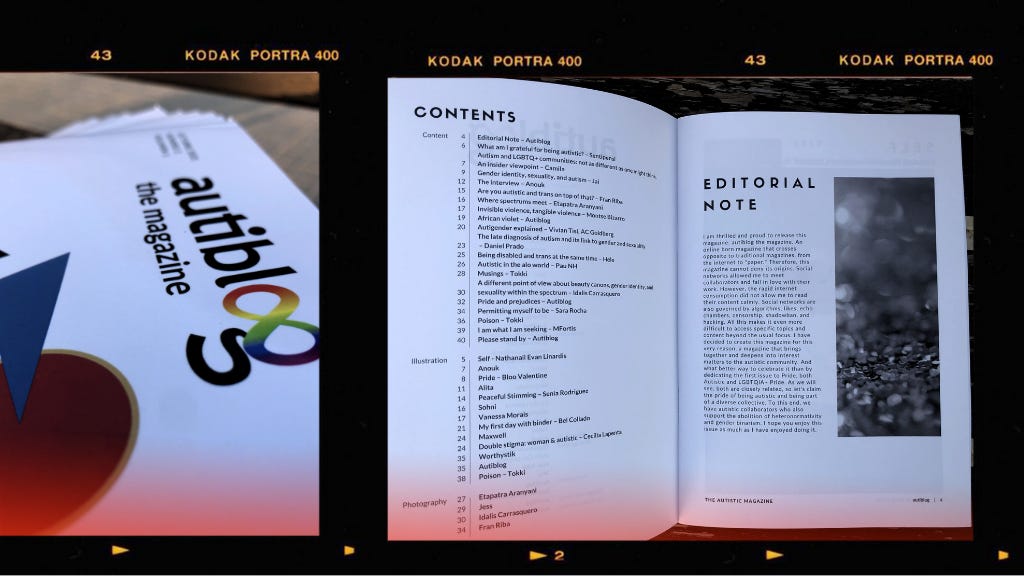
Talking with the creator of the autistic magazine, autiblog, about her autistic self-discovery, inspiration for starting autiblog, and design changes she's made in her life lately.

When did you have the idea for creating Autiblog The Magazine?
It's hard to say because I have so many ideas all the time. During those days, I was reflecting on the algorithm of instagram and how it shapes the content we see and create, thus resulting in echo chambers, i.e. endogamic environments. Plus, some autistic creators are shadow-banned; I needed a way to bypass all that. In addition, the information about autism in Spanish is completely outdated.
What ideas have you been interested in or exploring lately within the context of neurodivergence and advocacy?
I am interested in the models of disability and how neurotypical and capitalist conceptions of care affect disabled people.
At what age or in what period of your life did you find out you were autistic?
Around my 30s, after a massive burnout. Like many other autistic people, having burnout turns your whole life upside down. I questioned myself, who I was, and the life choices I took. I went down the rabbit hole until the word “autistic” started to make sense.
How was the process after?
Once I had the self-diagnosis clear, it was relatively fast. A few months later I was pursuing a professional diagnosis. Now I know that it’s not strictly necessary to obtain it, but the imposter syndrome was there: I wasn’t feeling autistic enough. Nonetheless, I needed like a whole year to get rid of the imposter syndrome. Even when I started the autiblog account I felt like a fraud. I wish the after-diagnosis was a more guided process, where you knew what to do or how to learn who you are. Unfortunately, it is an ocean of doubt.
What things have you (re)discovered about yourself since?
Many things. I know more about my mental processes, sensory issues, and how I interact with people. I am still learning to unmask and to discern the social persona from my own self. But I am also more aware of my limits and how to communicate those and I try to allow myself to enjoy the things I wasn’t supposed to enjoy, like hugging a stuffed animal. I wouldn’t change it for anything. Learning I am autistic is the best thing that has happened to me.
What are your favorite resources for learning about autism?
#ActuallyAutistic people on social media, I learn from the community every day.
Are there any autistic characters in tv, film, comics, or literature that you like or identify with?
I loved “Violet” from “As we see it”. In fact, the whole series is awesome as it shifts inwards the point of view. The whole autism description is “as they see us”, so I loved the first person in contrast. I liked “Quinni” from “Heartbreak High”.
What design or life changes have you made to cater to your accessibility needs that have made a positive difference in your life?
The noise-canceling headphones. I was hesitant at first due to the price, but they are worth every cent. I have also bought a hammock and I try to prioritize my needs every day.
What spaces, products, or events do you wish were more inclusive so you could easily participate in them?
I love traveling, but airports or bus stations are quite offputting. Museums, while usually peaceful, can become bustling and stressful at times. I wish they had a quiet hour and more chairs to sit down. And the same for public transport.
I also used to love music festivals, but I don’t think I can enjoy them anymore. When we organized the autistic market, I realized the importance of a sensory room. That is exactly what is needed in so many places, not to say everywhere! From universities to workplaces, from events to train stations. A cozy little place to actually rest on the go.
:)
You can follow Autiblog The Newsletter here on substack, as well as at @autiblog (Spanish) or @theautisticmagazine (English) where you can find the publication to buy a physical copy or read for free online.
Oh!! Thank you so much for your interview <3 I loved it!!